
June 2025 has been Men’s Health Month and with the current hype and media focus on the numerous benefits of Reformer Pilates, it would seem more men are being persuaded to try this form of exercise. Joe Wicks posted a video of himself working towards the splits earlier in the month, Novak Djokovic has been using the apparatus for years and our Instagram feed is full of basketball and football teams doing fitness exercises on a Contemporary Reformer. Even Jeremy Clarkson is in on the act.
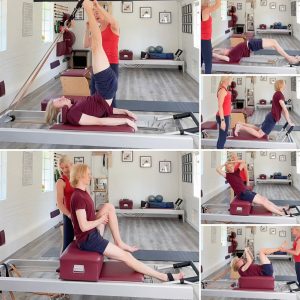
We’ve heard about the footballers and tennis players, so why are the power lifters, fitness gurus and racing drivers coming to Pilates? What does it offer them?
Recently I have been working with a wide range of male clients including a power-lifter training towards national competitions, an athlete rehabbing after international Ironman races, and a number of desk-bound commuters wanting to add more movement into their routine.
I asked Connor Wilde – powerlifter and PT at BTFitness and Fortify Fitness in Sudbury, why he thinks a wider variety of athletes are incorporating Pilates in to their routines, and what he gains from our work combined with his own regular stretching and mobility sessions. His answer? “They are crucial to preventing injuries and to help get in the best possible position for each lift. For example, a bigger extension for bench, help hit depth in squats, and achieve a more efficient position for deadlifts. The plyometric side is valuable so I can be as explosive as possible out of the hardest point of each lift or movement.”
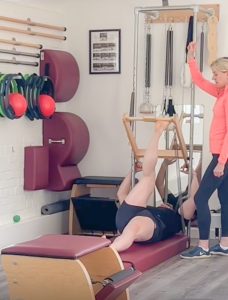
When deadlifting, the exercise starts with a squat which requires a deep hip hinge – and even greater dorsi-flexion at the ankle joint (which, by the way, not many people can access – just ask anyone who came to mat class last week!). When performing a bench press, the lumbar and mid-thoracic spine is moved into extension giving space for the shoulder blades and upper thoracic to take the strain. Pilates can help with all of these movement patterns.
What about other popular sports and activities? Long distance runners and cyclists also spend a lot of time moving in one direction – forwards! Golfers and swimmers add in a little rotation but are pretty much headed the same way – forwards. And those who are sat behind their desk all day? I think you know the answer.
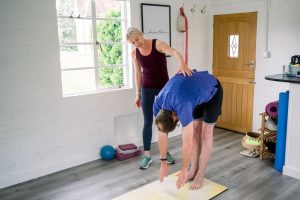
Then we add in the ‘age’ factor. Scott Baxter, physio at Edge Physio in Sudbury, comments “as we get older, we tend to hunch, so then lose thoracic and lumbar extension and rotation.” So if we stick to just one sport or fitness choice we may think we are staying fit but we could be reducing our ability to flex and rotate our spine. Not great for when you want to retire to the golf course and find you can’t rotate to swing your golf club or bend down to retrieve the ball from the 18th hole.
Neither can we necessarily strengthen our way out of pain. “I’ve been told to strengthen my glutes to sort out my hip pain” or “I need to work on my core to solve my lower back issues” are phrases I often hear when new clients come to the studio. If you head to the gym on your own or use weights and kettlebells at home, you may well be gaining strength, but you could well be strengthening alongside the original imbalances that potentially caused the pain in the first place. You would benefit from the trained eyes of a well-qualified PT or movement specialist. And a lesson on how to breathe – but that’s an entire blog on its own!
This month’s Men’s Health magazine features Ben Shephard at 50 saying he is in the best physical shape of his life. In the article, he states the journey to find this level of fitness was very different to the path he chose when he last appeared on the MH cover aged 36 years old. “I used to just turn up and do stuff. Now, I’m my more conscious of Pilates and stretching to protect my body” he says.
He goes on “A friend asked me what the one exercise was that made the biggest difference. It’s not an exercise, it’s consistency. Just turning up and being accountable.
This approach forms the foundation of Pilates. Joseph Pilates (he called his method of exercise Contrology; it didn’t become known as Pilates until several years after his death) famously wrote; “In 10 sessions, you will feel the difference. In 20 sessions, you will see the difference. And in 30 sessions, you will have a whole new body.”
Pilates wanted men and women to repeat his method 3 or 4 times a week, and he believed the result would be a long, healthy, pain-free life. He didn’t worry about what people thought they wanted to look like, it was more about how Contrology made them feel. He knew that strengthening and mobilising from the spine and centre allows us to move with freedom and ease stating “physical fitness is the first requisite of happiness.”
One client summarised his experience of Pilates, “starting as a novice, as a middle-aged man, I was most unsupple, to say the least, and for the first time, lacking in confidence in my physical ability. So, whilst comparatively still a novice at Pilates, I believe I have achieved moderate success in increasing my suppleness and core strength, but, more importantly, feel the confidence to be able to lead a ‘normal’ healthy life.” Every week, more men – and women – are turning to Pilates to future-proof their bodies.
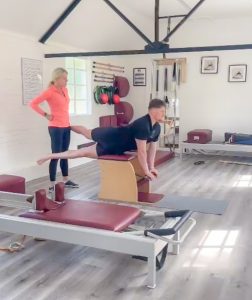
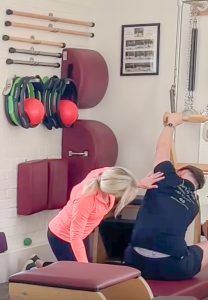
Pilates is a valuable addition to anyone’s exercise regimen, but particularly to those who move or sit in a repetitive way. In the studio, using the apparatus and mat, we honour the original method (Mr Pilates’ Contrology) and move with awareness of your body, your breath and your strength. Your body will be moved along every plane in every class. You will work the smaller muscles that often get missed in other activities. And your brain will have to focus so hard on what you are being asked to do that you won’t have a moment to think about work and the everyday stresses.


